




What is the voltage coefficient of cl21 - film capacitor?
 Aug 08, 2025|
 As a supplier of CL21 - film capacitors, I often encounter inquiries about various technical specifications of these components. One of the frequently asked questions is about the voltage coefficient of CL21 - film capacitors. In this blog post, I'll delve into what the voltage coefficient is, its significance for CL21 - film capacitors, and how it impacts their performance in different applications.
Understanding the Voltage Coefficient
The voltage coefficient of a capacitor is a measure of how the capacitance value of the capacitor changes with the applied voltage. It is usually expressed as a percentage change in capacitance per volt or per a certain voltage range. Mathematically, it can be defined as:
[
\text{Voltage Coefficient}=\frac{C_1 - C_2}{C_1}\times\frac{1}{V_1 - V_2}\times100%
]
where (C_1) and (C_2) are the capacitance values measured at voltages (V_1) and (V_2) respectively.
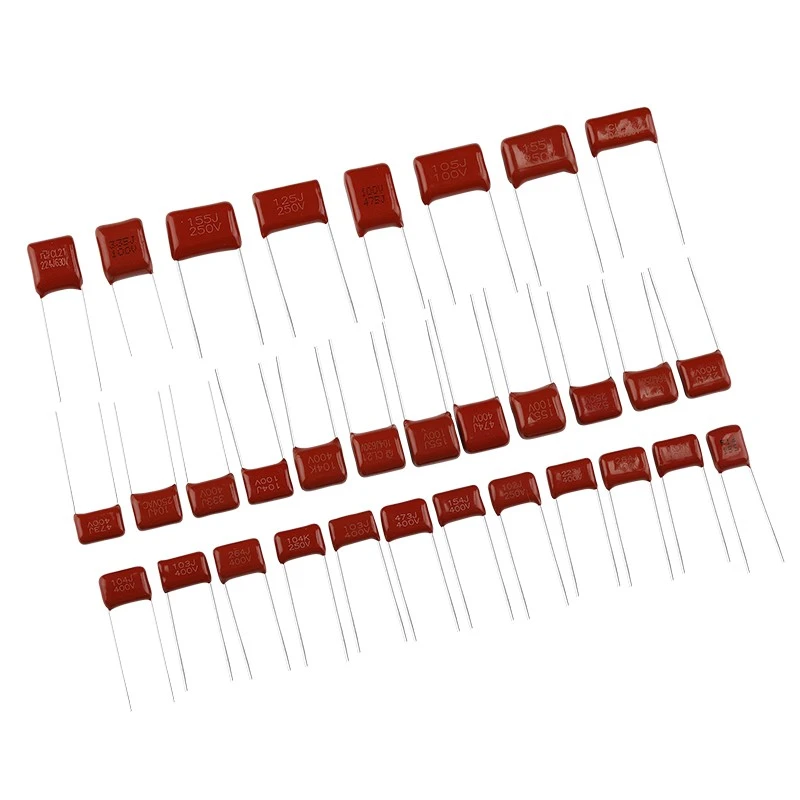
For CL21 - film capacitors, which are metalized polyester film capacitors, the voltage coefficient is an important characteristic because it directly affects the stability of the capacitance value under different operating voltages. A low voltage coefficient indicates that the capacitance value remains relatively stable as the applied voltage changes, which is crucial for many electronic circuits that require precise capacitance values.

Why the Voltage Coefficient Matters for CL21 - Film Capacitors
CL21 - film capacitors are widely used in various electronic applications, such as power supplies, lighting circuits, and audio equipment. In these applications, the stability of the capacitance value is often critical for the proper functioning of the circuit.
For example, in a power supply circuit, the CL21 - film capacitor may be used for filtering purposes. If the voltage coefficient of the capacitor is high, the capacitance value will change significantly as the input voltage fluctuates. This can lead to changes in the filtering characteristics of the circuit, resulting in poor power quality and potential interference issues.
In audio equipment, the stability of the capacitance value is also crucial for maintaining the correct frequency response. A capacitor with a high voltage coefficient may cause the frequency response of the audio circuit to vary with the applied voltage, leading to distortion and poor sound quality.
Factors Affecting the Voltage Coefficient of CL21 - Film Capacitors
Several factors can affect the voltage coefficient of CL21 - film capacitors. One of the main factors is the dielectric material used in the capacitor. Polyester film, which is the dielectric material in CL21 - film capacitors, has a certain degree of non - linearity in its electrical properties. As the applied voltage increases, the polarization of the dielectric material changes, which in turn affects the capacitance value.
The manufacturing process also plays an important role in determining the voltage coefficient. High - quality manufacturing processes can minimize the non - linearity of the dielectric material and reduce the voltage coefficient. For example, precise control of the film thickness and the metalization process can help to improve the stability of the capacitance value.
Typical Values of the Voltage Coefficient for CL21 - Film Capacitors
The voltage coefficient of CL21 - film capacitors typically ranges from a few parts per million per volt (ppm/V) to a few percent per volt, depending on the specific design and manufacturing process. For high - quality CL21 - film capacitors, the voltage coefficient can be as low as a few ppm/V, which means that the capacitance value changes very little with the applied voltage.
It's important to note that the voltage coefficient may also vary with temperature. In general, the voltage coefficient tends to increase at higher temperatures. Therefore, when selecting a CL21 - film capacitor for an application, it's necessary to consider both the voltage coefficient and the temperature coefficient to ensure the stability of the capacitance value under different operating conditions.
Applications and the Impact of Voltage Coefficient
Let's take a closer look at some specific applications and how the voltage coefficient of CL21 - film capacitors can impact their performance.
Power Factor Correction (PFC) Circuits
In PFC circuits, CL21 - film capacitors are used to improve the power factor of the electrical system. A stable capacitance value is essential for achieving accurate power factor correction. If the voltage coefficient of the capacitor is high, the capacitance value may change as the input voltage varies, leading to inaccurate power factor correction and reduced energy efficiency.
Lighting Circuits
In lighting circuits, especially those using LED drivers, CL21 - film capacitors are often used for filtering and decoupling purposes. A stable capacitance value is necessary to ensure the proper operation of the LED driver and to provide a constant current to the LEDs. A high voltage coefficient can cause the capacitance value to change with the input voltage, resulting in fluctuations in the LED current and potential flickering of the LEDs.
Audio Circuits
In audio circuits, CL21 - film capacitors are used in coupling and bypass applications. A stable capacitance value is crucial for maintaining the correct frequency response and minimizing distortion. A high voltage coefficient can cause the frequency response to vary with the applied voltage, leading to a change in the sound quality.
Selecting the Right CL21 - Film Capacitor Based on Voltage Coefficient
When selecting a CL21 - film capacitor for a specific application, it's important to consider the required voltage coefficient based on the application's requirements. For applications that require high precision and stability, such as audio equipment and high - performance power supplies, it's advisable to choose a capacitor with a low voltage coefficient.
At our company, we offer a wide range of CL21 - film capacitors with different voltage coefficients to meet the diverse needs of our customers. For example, our 1uf Polyester Capacitor and 2.2 Uf Polyester Capacitor are designed to provide stable capacitance values with low voltage coefficients. Our CL21 - Film Capacitor 100V is also a popular choice for various applications due to its excellent electrical performance and stability.
Conclusion
The voltage coefficient of CL21 - film capacitors is an important characteristic that directly affects the stability of the capacitance value under different operating voltages. Understanding the voltage coefficient and its impact on the performance of CL21 - film capacitors is crucial for selecting the right capacitor for a specific application.
As a supplier of CL21 - film capacitors, we are committed to providing high - quality products with low voltage coefficients to ensure the stability and reliability of our customers' electronic circuits. If you have any questions about the voltage coefficient of our CL21 - film capacitors or need assistance in selecting the right capacitor for your application, please feel free to contact us for further discussion and procurement negotiation.
References
- "Capacitor Handbook" by Johanson Dielectrics
- "Electronic Components and Circuit Theory" by Robert L. Boylestad and Louis Nashelsky