



Can Capacitor Axial be used in AC circuits?
 Jan 21, 2026|
As a supplier of Axial Capacitors, I often encounter questions from customers regarding the suitability of these components for AC circuits. This blog post aims to delve into this topic, providing a comprehensive analysis of whether Axial Capacitors can indeed be used in AC circuits.
Understanding Axial Capacitors
Axial capacitors are a type of capacitor with leads that extend axially from the body of the component. They come in various types, including ceramic, electrolytic, and film capacitors. Each type has its own unique characteristics, which determine its suitability for different applications.
Ceramic axial capacitors are known for their high capacitance values and excellent stability over a wide range of temperatures. They are commonly used in high-frequency applications, such as in radio frequency (RF) circuits. Electrolytic axial capacitors, on the other hand, offer high capacitance values in a relatively small package. They are often used in power supply circuits to filter out ripple voltage.
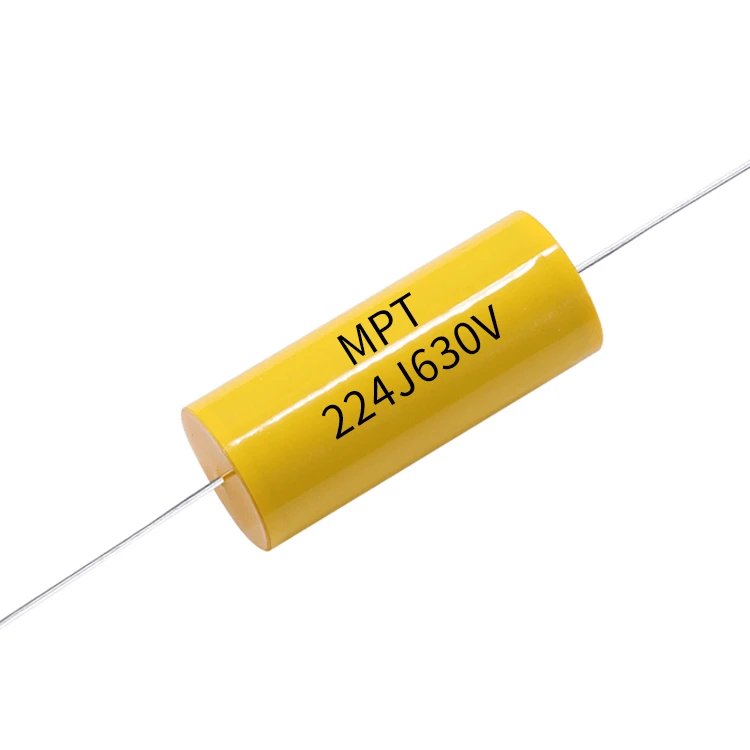
Film axial capacitors, like the CBB20-Axial Lead Film Capacitor 250V and CBB20-Axial Lead Film Capacitor 630V, are made from a thin plastic film that is coated with a metal layer. These capacitors are known for their low loss, high insulation resistance, and excellent self-healing properties. They are suitable for a wide range of applications, including AC circuits.
Characteristics of AC Circuits
AC circuits are characterized by the alternating flow of current, which changes direction periodically. The voltage in an AC circuit also varies sinusoidally with time. The frequency of the AC signal determines how quickly the current and voltage change direction.
In an AC circuit, capacitors play several important roles. They can be used to store and release electrical energy, filter out unwanted frequencies, and provide phase shift. However, not all capacitors are suitable for use in AC circuits. The choice of capacitor depends on several factors, including the voltage rating, capacitance value, frequency response, and temperature stability.
Suitability of Axial Capacitors for AC Circuits
The suitability of axial capacitors for AC circuits depends on the type of axial capacitor and the specific requirements of the AC circuit.
Film Axial Capacitors
Film axial capacitors, such as the CBB20 series, are well-suited for use in AC circuits. They have a low equivalent series resistance (ESR), which means they can handle high-frequency currents with minimal power loss. Their self-healing properties also make them reliable in AC applications, as they can withstand occasional overvoltage conditions without permanent damage.
For example, the 105J400V Axial Capacitors for IGBT Protection are designed to protect insulated-gate bipolar transistors (IGBTs) in AC circuits. These capacitors can handle high-voltage spikes and provide stable capacitance values over a wide range of temperatures.
Ceramic Axial Capacitors
Ceramic axial capacitors can also be used in AC circuits, especially in high-frequency applications. However, they have a relatively high dielectric loss, which can lead to power dissipation and heating at high frequencies. Therefore, they are typically used in applications where the frequency is relatively low or where the power requirements are not too high.
Electrolytic Axial Capacitors
Electrolytic axial capacitors are generally not recommended for use in AC circuits. They are polarized components, which means they can only be connected in one direction. Connecting an electrolytic capacitor in reverse polarity can cause it to overheat and fail. Additionally, electrolytic capacitors have a relatively high ESR and a limited frequency response, which makes them less suitable for AC applications.
Considerations When Using Axial Capacitors in AC Circuits
When using axial capacitors in AC circuits, several considerations should be taken into account:
Voltage Rating
The voltage rating of the capacitor must be higher than the maximum voltage that will be applied in the AC circuit. This ensures that the capacitor can withstand the voltage stress without breaking down.

Capacitance Value
The capacitance value of the capacitor determines its ability to store and release electrical energy. The appropriate capacitance value depends on the specific requirements of the AC circuit, such as the frequency of the signal and the amount of energy that needs to be stored.
Frequency Response
The frequency response of the capacitor determines how it behaves at different frequencies. In AC circuits, it is important to choose a capacitor with a frequency response that is suitable for the operating frequency of the circuit.
Temperature Stability
The temperature stability of the capacitor is important, especially in applications where the temperature can vary significantly. Capacitors with good temperature stability will maintain their capacitance value and other electrical properties over a wide range of temperatures.
Conclusion
In conclusion, axial capacitors can be used in AC circuits, but the choice of capacitor depends on the specific requirements of the circuit. Film axial capacitors, such as the CBB20 series, are well-suited for AC applications due to their low ESR, self-healing properties, and wide frequency response. Ceramic axial capacitors can also be used in high-frequency AC circuits, while electrolytic axial capacitors are generally not recommended for AC applications.
If you are looking for high-quality axial capacitors for your AC circuits, please feel free to contact us. We are a leading supplier of axial capacitors, offering a wide range of products to meet your specific needs. Our team of experts can provide you with technical support and guidance to help you choose the right capacitor for your application.
References
- Dorf, R. C., & Svoboda, J. A. (2018). Introduction to Electric Circuits. Wiley.
- Nilsson, J. W., & Riedel, S. A. (2019). Electric Circuits. Pearson.