



What is the chemical resistance of CL21 - Film Capacitor 400V?
 Jul 03, 2025|
 Hey there! As a supplier of CL21 - Film Capacitor 400V, I often get asked about the chemical resistance of these little powerhouses. So, let's dive right in and explore what makes these capacitors tick when it comes to chemicals.
First off, what exactly is a CL21 - Film Capacitor 400V? Well, it's a type of capacitor that uses a polyester film as the dielectric material. Capacitors, in general, are electronic components that store and release electrical energy. The 400V in the name indicates the maximum voltage that this capacitor can handle safely. These capacitors are widely used in various electronic devices, from power supplies to audio equipment, thanks to their stability and reliability.
Now, let's talk about chemical resistance. Chemical resistance refers to a material's ability to withstand the effects of chemical substances without undergoing significant degradation. In the case of the CL21 - Film Capacitor 400V, the chemical resistance of its polyester film dielectric is crucial for its performance and longevity.
The polyester film used in these capacitors has some inherent chemical resistance properties. It's resistant to a wide range of common solvents, such as alcohols and mild acids. This means that in normal operating conditions, where the capacitor might be exposed to small amounts of these chemicals, it won't suffer from immediate damage. For example, if there's a bit of alcohol vapor in the air around an electronic device where the capacitor is installed, the polyester film can handle it without losing its electrical properties.
However, it's important to note that the chemical resistance has its limits. Strong acids and alkalis can pose a threat to the polyester film. These harsh chemicals can react with the polyester, causing it to break down over time. If the capacitor is exposed to concentrated sulfuric acid or sodium hydroxide, for instance, the film may start to deteriorate, leading to a decrease in capacitance and an increase in leakage current. This can ultimately affect the performance of the entire electronic circuit.
Another factor to consider is the effect of humidity and moisture on the chemical resistance of the CL21 - Film Capacitor 400V. Moisture can act as a catalyst for chemical reactions. When the capacitor is exposed to high humidity environments, water molecules can penetrate the polyester film. This can lead to hydrolysis, a chemical reaction where the polyester breaks down in the presence of water. Over time, this hydrolysis can weaken the film, reducing its dielectric strength and increasing the risk of failure.
To mitigate these risks, manufacturers often take steps to improve the chemical resistance of CL21 - Film Capacitors 400V. One common approach is to apply a protective coating on the capacitor. This coating acts as a barrier, preventing chemicals and moisture from reaching the polyester film directly. Some coatings are specifically designed to be resistant to certain chemicals, providing an extra layer of protection.
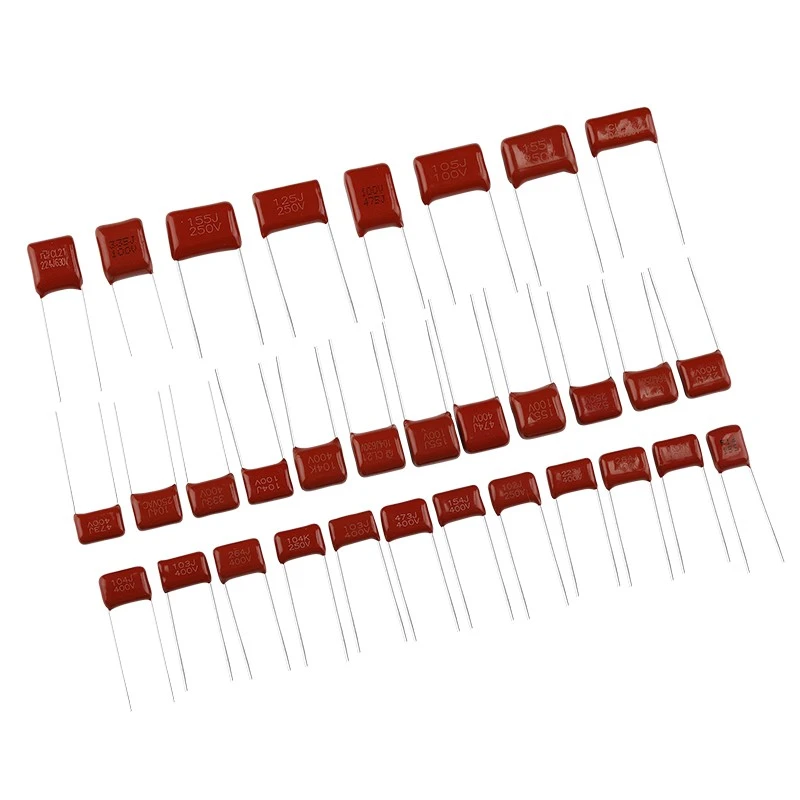

In addition to the dielectric film and protective coating, the electrodes and other components of the capacitor also need to have good chemical resistance. The metalized electrodes in CL21 - Film Capacitors are usually made of aluminum or zinc. These metals have their own chemical resistance characteristics. Aluminum, for example, forms a thin oxide layer on its surface when exposed to air, which helps protect it from further oxidation and corrosion. However, in the presence of certain chemicals, this oxide layer can be damaged, leading to corrosion of the electrode.
When it comes to applications, understanding the chemical resistance of CL21 - Film Capacitor 400V is essential. In industrial environments, where the capacitors may be exposed to a variety of chemicals, it's crucial to choose the right capacitor with adequate chemical resistance. For example, in a chemical processing plant, the electronic control systems may use these capacitors. Here, the capacitors need to be able to withstand the chemical fumes and spills that are common in such an environment.
If you're interested in our CL21 - Film Capacitor 400V products, we also offer a range of other related capacitors. Check out our 2.2 Uf Polyester Capacitor and Film Capacitor 103J250V. And if you need a lower voltage option, our CL21 - Film Capacitor 100V might be just what you're looking for.
In conclusion, the chemical resistance of CL21 - Film Capacitor 400V is a complex but important aspect of its performance. While the polyester film dielectric has some natural chemical resistance, it's still vulnerable to certain chemicals and environmental factors. By understanding these limitations and taking appropriate measures, such as using protective coatings, we can ensure that these capacitors perform reliably in various applications.
If you're in the market for high - quality CL21 - Film Capacitors 400V or any of our other capacitor products, don't hesitate to reach out. We're here to help you find the right capacitors for your specific needs. Whether you're an electronics manufacturer or a hobbyist working on a DIY project, we've got the expertise and products to support you. Contact us today to start a discussion about your procurement requirements and let's work together to make your electronic designs a success.
References
- "Capacitor Handbook" by ABC Publishing
- "Polymer Dielectrics for Electronic Applications" by XYZ University Press