




What is the transient response of CL21 - Film Capacitor 400V?
 Sep 16, 2025|
 Hey there! As a supplier of CL21-Film Capacitor 400V, I often get asked about the transient response of these little but mighty components. So, I thought I'd take a moment to break it down for you.
First off, let's understand what transient response means. In simple terms, transient response refers to how a capacitor reacts to sudden changes in voltage or current. These sudden changes can happen in all sorts of electrical circuits, like when a switch is turned on or off, or when there's a spike in the power supply.
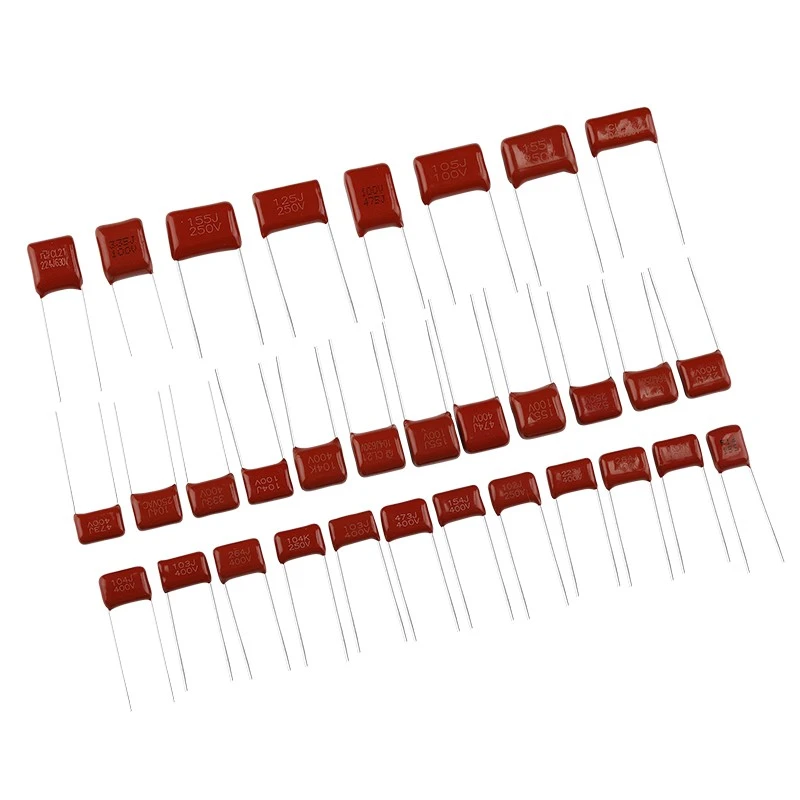
The CL21-Film Capacitor 400V is a type of metalized polyester film capacitor. It's known for its reliability, stability, and relatively low cost. But what about its transient response? Well, to get a good grasp of it, we need to look at a few key factors.
Capacitance and Resistance
The capacitance value of the CL21-Film Capacitor 400V plays a big role in its transient response. Capacitance is basically a measure of how much electrical charge a capacitor can store. A higher capacitance means the capacitor can store more charge, which can be useful in handling sudden changes in voltage.
When a transient voltage spike occurs, the capacitor will start to charge or discharge depending on the direction of the spike. The rate at which it does this is influenced by its equivalent series resistance (ESR). A lower ESR means the capacitor can charge and discharge more quickly, which is great for a fast transient response.
Dielectric Material
The dielectric material in the CL21-Film Capacitor 400V is polyester film. This material has some unique properties that affect the transient response. Polyester film has a relatively high dielectric constant, which means it can store a lot of electrical energy in a small volume.
However, it also has a certain amount of dielectric absorption. Dielectric absorption is like a memory effect in the capacitor. When the capacitor is charged and then discharged, a small amount of the charge can get trapped in the dielectric material. This can cause a delayed discharge, which might affect the transient response in some applications.
Frequency Response
The transient response of the CL21-Film Capacitor 400V is also related to its frequency response. Transients often contain high-frequency components, so the capacitor needs to be able to handle these frequencies effectively.
The CL21-Film Capacitor 400V has a good frequency response up to a certain range. But as the frequency gets very high, the impedance of the capacitor starts to increase. This can limit its ability to respond quickly to high-frequency transients.
Applications and Transient Response
Now, let's talk about how the transient response of the CL21-Film Capacitor 400V matters in different applications.
In power supply circuits, transient responses are crucial. When there's a sudden change in the load, the power supply needs to be able to adjust quickly. The CL21-Film Capacitor 400V can be used to filter out high-frequency noise and smooth out the voltage. Its ability to handle transient spikes helps protect other components in the circuit from damage.
In audio circuits, the transient response can affect the sound quality. A capacitor with a good transient response can accurately reproduce sudden changes in the audio signal, resulting in a more dynamic and realistic sound.
Comparing with Other Capacitors
How does the CL21-Film Capacitor 400V stack up against other types of capacitors in terms of transient response? Well, compared to electrolytic capacitors, the CL21-Film Capacitor 400V generally has a faster transient response. Electrolytic capacitors often have a higher ESR, which can slow down their charging and discharging times.
On the other hand, ceramic capacitors can have an even faster transient response in some cases. But they might not have the same level of capacitance as the CL21-Film Capacitor 400V. So, it really depends on the specific requirements of the application.
Improving Transient Response
If you need to improve the transient response of the CL21-Film Capacitor 400V in your circuit, there are a few things you can do. One option is to use multiple capacitors in parallel. This can effectively reduce the overall ESR and increase the capacitance, which can lead to a faster transient response.
Another approach is to choose a capacitor with a lower ESR value. Some manufacturers offer CL21-Film Capacitors 400V with optimized ESR for better transient performance.
Related Products
If you're interested in other related products, we also offer CL21-Film Capacitor 630V and 2.2 Uf Polyester Capacitor. These capacitors have similar characteristics but might be more suitable for different voltage requirements or capacitance values.

Conclusion
In conclusion, the transient response of the CL21-Film Capacitor 400V is an important aspect to consider when using it in electrical circuits. Its capacitance, ESR, dielectric material, and frequency response all play a role in how it reacts to sudden changes in voltage or current.
Whether you're working on a power supply circuit, an audio system, or any other application, understanding the transient response can help you make the most of this capacitor. And if you have any questions or are interested in purchasing our CL21-Film Capacitor 400V, feel free to reach out for a procurement discussion. We're here to help you find the best solution for your needs.
References
- "Capacitor Handbook" by various authors
- Manufacturer's datasheets for CL21-Film Capacitor 400V