




What is the impedance of Capacitor Axial?
 Nov 05, 2025|
 Hey there! As a supplier of Capacitor Axial, I often get asked about the impedance of these little guys. So, I thought I'd sit down and write a blog post to share some insights on what the impedance of Capacitor Axial really is.
First off, let's quickly understand what impedance is. Impedance is a measure of the opposition that a circuit presents to a current when a voltage is applied. It's a complex quantity that combines both resistance and reactance. In the case of a capacitor, the impedance is a bit different from that of a resistor.
For a Capacitor Axial, the impedance (Z) is given by the formula (Z = \frac{1}{j\omega C}), where (j) is the imaginary unit ((j=\sqrt{- 1})), (\omega) is the angular frequency ((\omega = 2\pi f), with (f) being the frequency of the alternating current), and (C) is the capacitance of the capacitor.
The impedance of a Capacitor Axial is inversely proportional to the frequency of the applied AC signal and the capacitance value. This means that as the frequency increases, the impedance of the capacitor decreases. And as the capacitance increases, the impedance also decreases.
Let's break this down a bit further. At low frequencies, the impedance of a Capacitor Axial is relatively high. This is because the capacitor has more time to charge and discharge, and it acts more like an open circuit. As the frequency goes up, the capacitor charges and discharges more rapidly, and its impedance drops.
For example, if you have a Capacitor Axial with a capacitance of (1\ \mu F) and you apply an AC signal with a frequency of (100\ Hz), the angular frequency (\omega=2\pi\times100\approx 628\ rad/s). Using the impedance formula (Z=\frac{1}{j\omega C}), we get (Z=\frac{1}{j\times628\times1\times10^{- 6}}). Since (j) is in the denominator, we can rewrite it as (Z = -j\frac{1}{628\times1\times10^{-6}}\approx -j1592\ \Omega). The negative imaginary part indicates that the impedance of the capacitor is a capacitive reactance.
Now, let's talk about how this impedance characteristic affects the performance of Capacitor Axial in different applications.
In audio circuits, the impedance of Capacitor Axial plays a crucial role. Audio signals have a wide range of frequencies, typically from (20\ Hz) to (20\ kHz). Capacitors are used in audio circuits for coupling, filtering, and tone control. For coupling applications, we want the capacitor to pass the audio signal with minimal loss. A capacitor with a low impedance at the audio frequencies will allow the signal to pass through easily. That's why Best Film Capacitors for Audio are carefully selected based on their impedance characteristics at the relevant audio frequencies.
In power supply circuits, Capacitor Axial are used for smoothing the DC output. The capacitor helps to reduce the ripple voltage by storing and releasing energy as needed. At the ripple frequency, the capacitor should have a low impedance so that it can effectively bypass the AC component of the ripple.
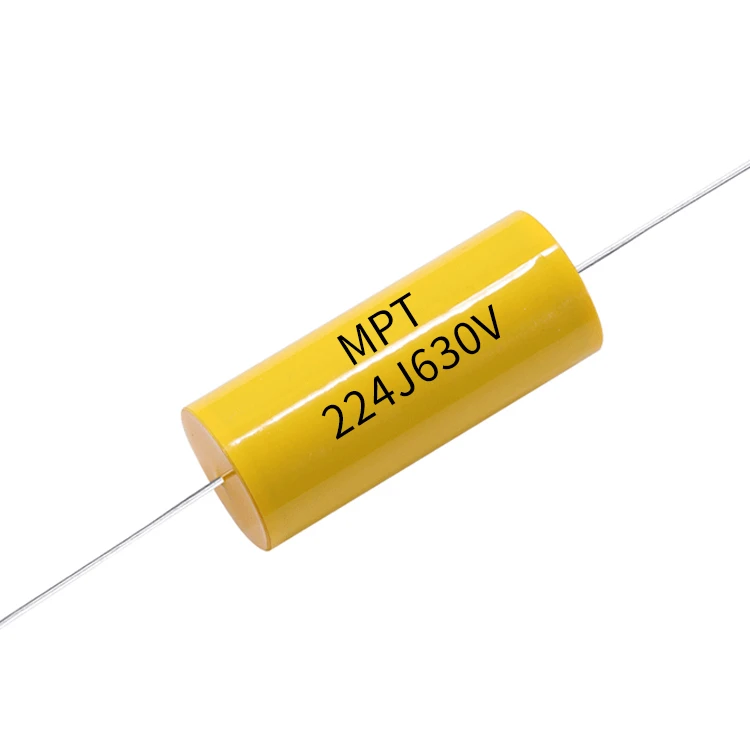

As a supplier, we offer a variety of Capacitor Axial products, such as CBB20 - Axial Lead Film Capacitor 250V and CBB20 - Axial Lead Film Capacitor 630V. These capacitors are made with high - quality materials and are designed to have stable impedance characteristics over a wide range of frequencies and temperatures.
The impedance of our Capacitor Axial is carefully measured and tested during the manufacturing process. We use advanced testing equipment to ensure that each capacitor meets the specified impedance requirements. This way, our customers can be confident that they are getting a reliable product for their applications.
Another factor that can affect the impedance of Capacitor Axial is the temperature. As the temperature changes, the capacitance value of the capacitor may also change slightly. This, in turn, can affect the impedance. However, our film capacitors are designed to have a low temperature coefficient, which means that the change in impedance with temperature is minimized.
When choosing a Capacitor Axial for your application, it's important to consider the impedance requirements. You need to know the frequency range of the signal that the capacitor will be exposed to and select a capacitor with an appropriate impedance at those frequencies.
If you're in the market for high - quality Capacitor Axial, look no further. We have a wide selection of products to meet your needs. Whether you're working on an audio project, a power supply design, or any other application that requires capacitors, we can provide you with the right solution.
If you have any questions about the impedance of our Capacitor Axial or need help in selecting the right capacitor for your project, don't hesitate to reach out. We're here to assist you with all your capacitor - related needs. Contact us today to start a discussion about your procurement requirements and let's find the perfect Capacitor Axial for your application.
References
- "The Art of Electronics" by Paul Horowitz and Winfield Hill
- "Fundamentals of Electric Circuits" by Charles K. Alexander and Matthew N. O. Sadiku