




What is the energy storage capacity of Mkp Capacitors?
 Sep 09, 2025|
 As a supplier of Mkp Capacitors, I've often been asked about the energy storage capacity of these remarkable components. In this blog, I'll delve into the science behind Mkp Capacitors and explain their energy storage capabilities.
Understanding Mkp Capacitors
Mkp Capacitors, also known as Metalized Polypropylene Film Capacitors, are widely used in various electrical and electronic applications. They are constructed using a thin polypropylene film that is metallized with a thin layer of metal, typically aluminum. This metallized film serves as the electrodes of the capacitor, while the polypropylene film acts as the dielectric.
The use of polypropylene as the dielectric material offers several advantages. Polypropylene has a high dielectric strength, which means it can withstand high voltages without breaking down. It also has a low dielectric loss, which results in low power dissipation and high efficiency. Additionally, polypropylene has excellent self - healing properties. If a small puncture occurs in the dielectric due to a high - voltage spike, the metal layer around the puncture vaporizes, isolating the damaged area and preventing further breakdown.
Energy Storage in Capacitors
The energy stored in a capacitor is given by the formula (E=\frac{1}{2}CV^{2}), where (E) is the energy in joules (J), (C) is the capacitance in farads (F), and (V) is the voltage across the capacitor in volts (V). This formula shows that the energy storage capacity of a capacitor depends on two main factors: its capacitance and the voltage it can withstand.
Capacitance
Capacitance is a measure of a capacitor's ability to store electrical charge. It is determined by the physical characteristics of the capacitor, such as the area of the electrodes, the distance between the electrodes, and the dielectric constant of the material between the electrodes. In Mkp Capacitors, the capacitance can be adjusted by changing the size and shape of the metallized film, as well as the number of layers of the film.
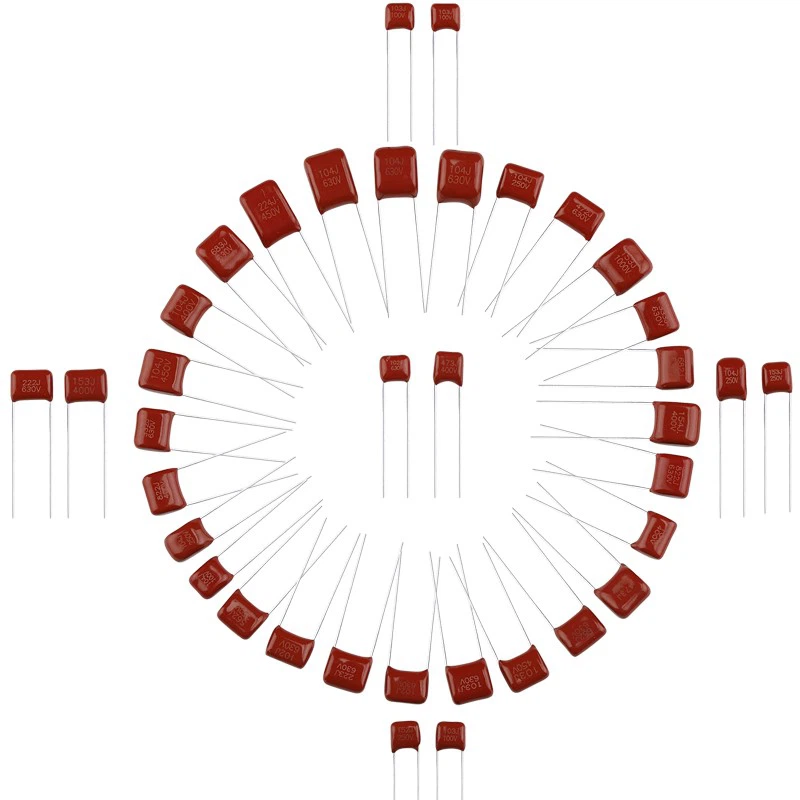
For example, a 335j 400v Capacitor has a specific capacitance value. The code "335" indicates the capacitance value in picofarads. Using the standard capacitor coding system, "335" means (33\times10^{5}) pF, which is equal to 3.3 μF.
Voltage Rating
The voltage rating of a capacitor is the maximum voltage that it can safely withstand without experiencing dielectric breakdown. In Mkp Capacitors, the voltage rating is determined by the thickness and quality of the polypropylene dielectric. A higher - voltage - rated capacitor can store more energy because, according to the energy formula (E = \frac{1}{2}CV^{2}), increasing the voltage has a squared effect on the energy storage.
For instance, a Cbb21 105j400v capacitor has a voltage rating of 400V. The "105" in the code represents a capacitance of (10\times10^{5}) pF or 1 μF. Using the energy formula (E=\frac{1}{2}CV^{2}), with (C = 1\times10^{- 6}) F and (V = 400) V, we can calculate the energy stored as (E=\frac{1}{2}\times(1\times10^{-6})\times(400)^{2}=0.08) J.
Factors Affecting Energy Storage Capacity
Temperature
Temperature can have a significant impact on the energy storage capacity of Mkp Capacitors. As the temperature increases, the dielectric constant of the polypropylene film may change slightly, which can affect the capacitance. Additionally, high temperatures can increase the dielectric loss, leading to reduced efficiency and potentially lower energy storage capacity. Most Mkp Capacitors are designed to operate within a specific temperature range, typically from - 40°C to + 85°C or - 55°C to + 105°C, depending on the application requirements.
Frequency
The frequency of the applied voltage also affects the performance of Mkp Capacitors. At high frequencies, the dielectric loss may increase, which can reduce the efficiency and energy storage capacity. However, Mkp Capacitors generally have good frequency characteristics due to the low dielectric loss of the polypropylene film. They are suitable for use in a wide range of frequencies, from a few hertz to several megahertz.
Applications and Energy Storage Requirements
Mkp Capacitors are used in a variety of applications, each with different energy storage requirements.

Power Factor Correction
In power factor correction applications, Mkp Capacitors are used to improve the power factor of electrical systems. The energy storage capacity in these applications is relatively low, but the capacitors need to be able to handle high - frequency currents and voltages. For example, in a small industrial motor, a capacitor with a capacitance of a few microfarads and a voltage rating of a few hundred volts may be sufficient to correct the power factor.
Pulse Power Applications
In pulse power applications, such as laser power supplies and electromagnetic launchers, Mkp Capacitors need to store and release large amounts of energy in a short period. These applications require capacitors with high capacitance and high - voltage ratings. A CBB21 - Film Capacitor 100V may be used in some lower - voltage pulse power circuits, where the energy storage needs are more modest.
Conclusion
The energy storage capacity of Mkp Capacitors is determined by their capacitance and voltage rating, as well as external factors such as temperature and frequency. These capacitors offer a combination of high - voltage withstand, low dielectric loss, and self - healing properties, making them suitable for a wide range of applications.
If you are in need of Mkp Capacitors for your specific application and want to discuss the energy storage requirements, we are here to help. Our team of experts can provide you with detailed information about our product range and assist you in selecting the right capacitor for your needs. Contact us to start a procurement discussion and find the best solution for your electrical and electronic projects.
References
- Dorf, R. C., & Svoboda, J. A. (2018). Introduction to Electric Circuits. Wiley.
- Terman, F. E. (1955). Electronic and Radio Engineering. McGraw - Hill.