




What is the dissipation factor of Cbb21?
 Jul 08, 2025|
 As a dedicated supplier of Cbb21 capacitors, I often encounter inquiries from customers regarding various technical specifications of these components. One question that frequently arises is, "What is the dissipation factor of Cbb21?" In this blog post, I aim to provide a comprehensive answer to this question, delving into the concept of the dissipation factor, its significance in Cbb21 capacitors, and how it impacts their performance.
Understanding the Dissipation Factor
The dissipation factor, also known as the loss tangent (tan δ), is a crucial parameter that quantifies the energy loss in a capacitor when it is subjected to an alternating current (AC). In an ideal capacitor, all the electrical energy stored during the charging phase would be completely released during the discharging phase. However, in real-world capacitors, a small fraction of the energy is lost in the form of heat due to various internal mechanisms. The dissipation factor is a measure of this energy loss.
Mathematically, the dissipation factor is defined as the ratio of the equivalent series resistance (ESR) to the capacitive reactance (Xc) of the capacitor at a given frequency:
[ \tan \delta = \frac{ESR}{X_c} ]
where ( ESR ) is the equivalent series resistance and ( X_c = \frac{1}{2\pi fC} ) is the capacitive reactance, with ( f ) being the frequency of the AC signal and ( C ) being the capacitance of the capacitor.
Dissipation Factor in Cbb21 Capacitors
Cbb21 capacitors are a type of metallized polypropylene film capacitors known for their excellent electrical properties, high reliability, and wide range of applications. These capacitors are constructed using a thin polypropylene film as the dielectric material, which is metallized on one or both sides to form the electrodes.
The dissipation factor of Cbb21 capacitors is typically very low, usually in the range of 0.001 to 0.002 at a frequency of 1 kHz. This low dissipation factor is one of the key advantages of Cbb21 capacitors, as it indicates that they have low energy losses and high efficiency. A low dissipation factor also means that the capacitors generate less heat during operation, which can improve their long-term reliability and stability.
The low dissipation factor of Cbb21 capacitors is primarily due to the high-quality polypropylene film used as the dielectric material. Polypropylene has a very low dielectric loss, which means that it can store and release electrical energy with minimal losses. Additionally, the metallized electrodes in Cbb21 capacitors are designed to have low resistance, which further reduces the equivalent series resistance and, consequently, the dissipation factor.
Significance of the Dissipation Factor in Cbb21 Capacitors
The dissipation factor plays a crucial role in determining the performance and suitability of Cbb21 capacitors for various applications. Here are some of the key implications of the dissipation factor in Cbb21 capacitors:
1. Efficiency
As mentioned earlier, a low dissipation factor indicates that the capacitor has low energy losses and high efficiency. In applications where energy efficiency is critical, such as power supplies and renewable energy systems, Cbb21 capacitors with low dissipation factors can help reduce power consumption and improve the overall system efficiency.
2. Heat Generation
The dissipation factor is directly related to the amount of heat generated by the capacitor during operation. A high dissipation factor means that the capacitor will generate more heat, which can lead to increased temperature rise and potentially reduce the lifespan of the capacitor. In contrast, Cbb21 capacitors with low dissipation factors generate less heat, which can improve their reliability and stability, especially in high-power applications.
3. Frequency Response
The dissipation factor of a capacitor can vary with frequency. In general, the dissipation factor of Cbb21 capacitors increases with increasing frequency. However, the rate of increase is relatively small compared to other types of capacitors. This makes Cbb21 capacitors suitable for use in high-frequency applications, such as radio frequency (RF) circuits and telecommunications systems, where they can maintain low energy losses and good performance over a wide frequency range.
4. Signal Quality
In applications where signal quality is important, such as audio and video circuits, the dissipation factor can affect the performance of the capacitor. A high dissipation factor can cause distortion and attenuation of the signal, leading to a degradation in the overall signal quality. Cbb21 capacitors with low dissipation factors can help minimize these effects and ensure high-quality signal transmission.
Factors Affecting the Dissipation Factor of Cbb21 Capacitors
Several factors can affect the dissipation factor of Cbb21 capacitors. Here are some of the key factors to consider:
1. Frequency
As mentioned earlier, the dissipation factor of Cbb21 capacitors generally increases with increasing frequency. This is because the capacitive reactance decreases with increasing frequency, while the equivalent series resistance remains relatively constant. As a result, the ratio of the equivalent series resistance to the capacitive reactance, which is the dissipation factor, increases.
2. Temperature
The dissipation factor of Cbb21 capacitors can also be affected by temperature. In general, the dissipation factor increases with increasing temperature. This is because the resistance of the metallized electrodes and the dielectric loss of the polypropylene film increase with temperature. Therefore, it is important to consider the operating temperature range of the capacitor when selecting a Cbb21 capacitor for a specific application.
3. Capacitance Value
The dissipation factor of Cbb21 capacitors can vary slightly with the capacitance value. In general, larger capacitance values tend to have slightly higher dissipation factors. This is because larger capacitors have more dielectric material and a larger surface area, which can increase the equivalent series resistance and the dielectric loss.
Applications of Cbb21 Capacitors with Low Dissipation Factors
Due to their low dissipation factors and excellent electrical properties, Cbb21 capacitors are widely used in a variety of applications. Here are some of the common applications of Cbb21 capacitors:
1. Power Supplies
In power supply circuits, Cbb21 capacitors are used for filtering, decoupling, and energy storage. Their low dissipation factors help reduce power losses and improve the efficiency of the power supply. Additionally, the low heat generation of Cbb21 capacitors can improve the reliability and stability of the power supply.
2. Audio and Video Circuits
In audio and video circuits, Cbb21 capacitors are used for coupling, bypassing, and frequency compensation. Their low dissipation factors help ensure high-quality signal transmission and minimize distortion and attenuation.
3. Radio Frequency (RF) Circuits
In RF circuits, Cbb21 capacitors are used for tuning, coupling, and filtering. Their low dissipation factors and good frequency response make them suitable for use in high-frequency applications, such as wireless communication systems and radar systems.
4. Renewable Energy Systems
In renewable energy systems, such as solar power and wind power systems, Cbb21 capacitors are used for power conditioning, energy storage, and filtering. Their low dissipation factors help improve the efficiency of the renewable energy systems and reduce power losses.
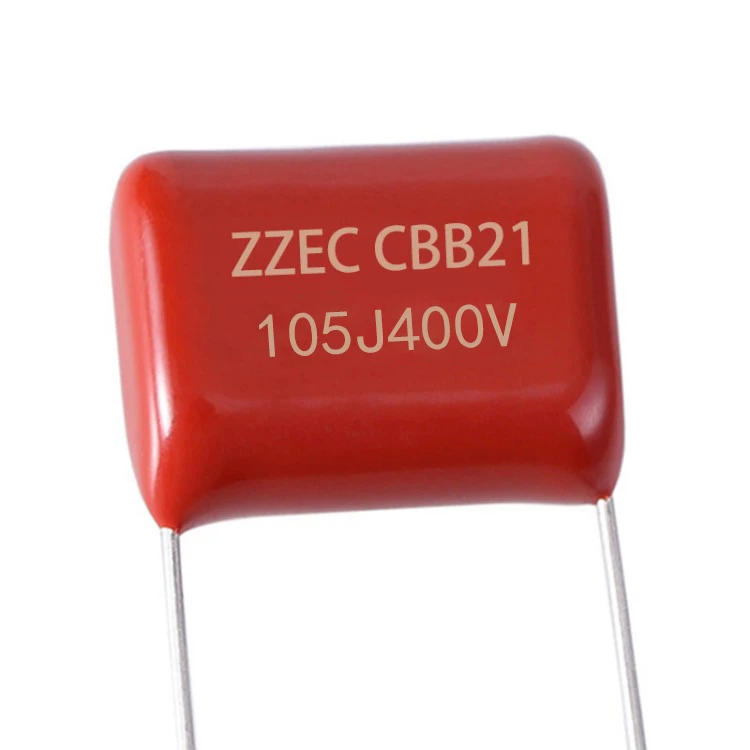

Our Cbb21 Capacitor Products
As a leading supplier of Cbb21 capacitors, we offer a wide range of high-quality Cbb21 capacitors with low dissipation factors. Our Cbb21 capacitors are available in various capacitance values, voltage ratings, and package sizes to meet the diverse needs of our customers. Some of our popular Cbb21 capacitor products include:
- Cbb21 105j400v: This capacitor has a capacitance of 1 μF, a voltage rating of 400 V, and a low dissipation factor of 0.001 at 1 kHz. It is suitable for use in power supplies, audio circuits, and other applications where high reliability and low energy losses are required.
- CBB21-Film Capacitor 100V: This capacitor has a voltage rating of 100 V and is available in various capacitance values. It is designed for use in low-voltage applications, such as consumer electronics and telecommunications systems.
- CBB21-Film Capacitor 200V: This capacitor has a voltage rating of 200 V and is suitable for use in medium-voltage applications, such as industrial control systems and power electronics.
Conclusion
In conclusion, the dissipation factor is a crucial parameter that quantifies the energy loss in Cbb21 capacitors. Cbb21 capacitors are known for their low dissipation factors, which indicate that they have low energy losses, high efficiency, and good performance. The low dissipation factor of Cbb21 capacitors is primarily due to the high-quality polypropylene film used as the dielectric material and the low-resistance metallized electrodes.
The dissipation factor plays a significant role in determining the performance and suitability of Cbb21 capacitors for various applications. A low dissipation factor can improve the efficiency, reliability, and signal quality of the capacitors, making them suitable for use in a wide range of applications, including power supplies, audio and video circuits, RF circuits, and renewable energy systems.
If you are looking for high-quality Cbb21 capacitors with low dissipation factors, please feel free to contact us for more information and to discuss your specific requirements. We are committed to providing our customers with the best products and services, and we look forward to working with you.
References
- "Capacitor Handbook", Eaton Corporation
- "Electrical Engineering Handbook", CRC Press
- "Fundamentals of Electric Circuits", Charles K. Alexander and Matthew N. O. Sadiku