




What is the difference in application between DC and AC for Cbb21?
 Dec 04, 2025|
 In the realm of electronic components, capacitors play a pivotal role, and among them, the Cbb21 capacitor stands out for its wide - ranging applications. As a trusted Cbb21 supplier, I've witnessed firsthand the diverse needs of customers and the importance of understanding the difference in application between DC (Direct Current) and AC (Alternating Current) for Cbb21 capacitors.
Understanding Cbb21 Capacitors
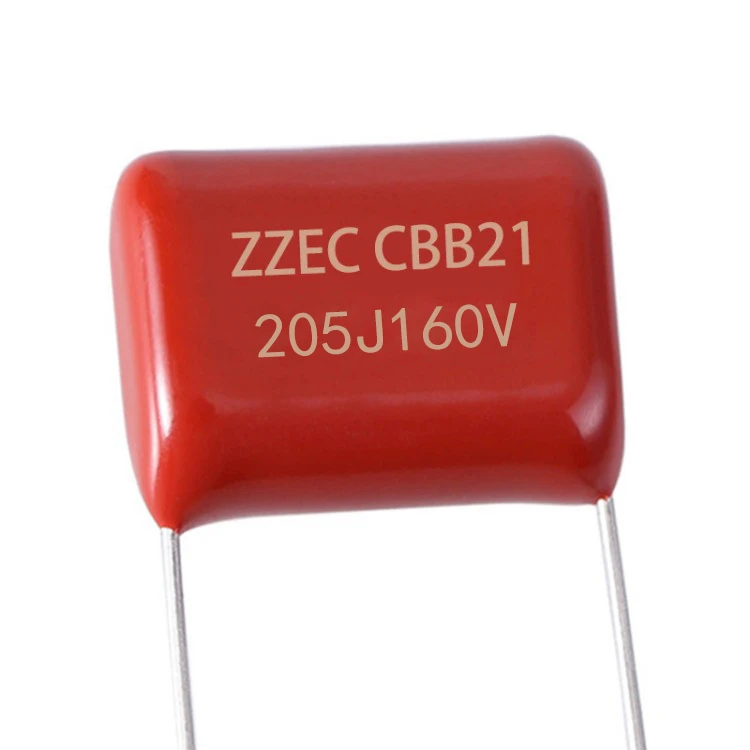
Before delving into the DC and AC applications, let's first understand what Cbb21 capacitors are. Cbb21 capacitors are metalized polypropylene film capacitors. They are known for their excellent electrical properties, such as low loss, high insulation resistance, and good self - healing characteristics. These features make them suitable for a variety of electronic circuits. You can find more information about Cbb21 capacitors on our website Cbb21.
DC Applications of Cbb21 Capacitors
Filtering in Power Supplies
One of the most common DC applications of Cbb21 capacitors is in power supply filtering. In a DC power supply, the output voltage may contain some ripple, which is an unwanted AC component. Cbb21 capacitors can be used to smooth out this ripple. They act as energy storage elements, charging when the voltage is high and discharging when the voltage is low. For example, in a linear power supply, a Cbb21 capacitor can be connected in parallel with the load to reduce the ripple voltage. This helps in providing a more stable DC voltage to the electronic devices, which is crucial for their proper operation.
Coupling and Decoupling
In DC - coupled amplifier circuits, Cbb21 capacitors are used for coupling and decoupling purposes. Coupling capacitors are used to transfer the AC component of a signal from one stage of an amplifier to the next while blocking the DC component. This allows different stages of the amplifier to have different DC bias voltages without interfering with each other. Decoupling capacitors, on the other hand, are used to provide a local reservoir of charge to the power pins of integrated circuits. They help in reducing the noise and interference caused by the rapid switching of digital circuits. For instance, in a microcontroller - based circuit, a Cbb21 capacitor can be placed near the power pins of the microcontroller to ensure a clean power supply.
Timing Circuits
Cbb21 capacitors can also be used in DC - based timing circuits. In a simple RC (Resistor - Capacitor) timing circuit, the time constant (τ = RC) determines the charging and discharging time of the capacitor. By using a Cbb21 capacitor with a known capacitance value and a resistor, we can create a timing circuit for applications such as pulse generation, delay circuits, and oscillator circuits. For example, in a monostable multivibrator circuit, the Cbb21 capacitor and a resistor work together to determine the duration of the output pulse.
AC Applications of Cbb21 Capacitors
AC Motor Start and Run
In AC motor applications, Cbb21 capacitors are used for both starting and running the motor. In a single - phase AC motor, a capacitor is used to create a phase shift between the main winding and the auxiliary winding. This phase shift produces a rotating magnetic field, which is necessary for the motor to start and run. For starting, a larger - value capacitor is used to provide a high starting torque. Once the motor reaches a certain speed, a smaller - value capacitor may be used for running the motor more efficiently. For example, in a small household fan motor, a Cbb21 capacitor can be used to ensure smooth starting and operation.
Power Factor Correction
In AC power systems, the power factor is an important parameter. A low power factor means that the electrical equipment is not using the electrical power efficiently. Cbb21 capacitors can be used for power factor correction. They are connected in parallel with the inductive loads, such as motors and transformers. The capacitor provides a leading current, which counteracts the lagging current of the inductive load. This helps in improving the power factor of the system, reducing the reactive power and the overall energy consumption. For industrial applications where large inductive loads are used, power factor correction using Cbb21 capacitors can result in significant energy savings.

AC Signal Processing
In AC signal processing circuits, Cbb21 capacitors are used for frequency - selective applications. For example, in a band - pass filter circuit, a combination of capacitors and inductors or resistors is used to allow only a certain range of frequencies to pass through. Cbb21 capacitors can be used in these circuits due to their stable electrical properties over a wide range of frequencies. They can also be used in audio circuits for tone control, where they help in adjusting the bass, mid - range, and treble frequencies.
Differences in Design Considerations for DC and AC Applications
Voltage Rating
When using Cbb21 capacitors in DC applications, the voltage rating of the capacitor should be chosen based on the maximum DC voltage that the capacitor will experience in the circuit. For example, if the DC voltage in a power supply is 12V, a capacitor with a voltage rating higher than 12V, such as CBB21 - Film Capacitor 160V, should be selected to ensure safety and reliability.
In AC applications, the voltage rating of the capacitor is more complex. The capacitor needs to withstand the peak value of the AC voltage. Since the peak value of an AC voltage is √2 times the RMS (Root - Mean - Square) value, a capacitor with a higher voltage rating is required. For example, in a 220V RMS AC circuit, the peak voltage is approximately 311V. So, a capacitor with a voltage rating higher than 311V, such as CBB21 - Film Capacitor 400V, should be used.
Frequency Response
DC applications generally do not have a frequency - related issue as the current flows in one direction only. However, in AC applications, the frequency response of the capacitor is crucial. Cbb21 capacitors have a certain frequency range over which their electrical properties remain stable. At high frequencies, the equivalent series resistance (ESR) and equivalent series inductance (ESL) of the capacitor can affect its performance. So, for high - frequency AC applications, the capacitor should be selected based on its frequency response characteristics.
Conclusion
In conclusion, the Cbb21 capacitor has distinct applications in both DC and AC circuits. Understanding these differences is essential for proper circuit design and selection of the appropriate capacitor. Whether it's for power supply filtering in DC circuits or power factor correction in AC circuits, Cbb21 capacitors offer reliable performance. As a Cbb21 supplier, we are committed to providing high - quality capacitors to meet the diverse needs of our customers. If you have any requirements for Cbb21 capacitors or need more technical support, please feel free to contact us for procurement and further discussions.
References
- Dorf, R. C., & Svoboda, J. A. (2016). Introduction to Electric Circuits. Wiley.
- Boylestad, R. L., & Nashelsky, L. (2017). Electronic Devices and Circuit Theory. Pearson.