




Is Mkp 275v X2 suitable for filter circuits?
 Oct 29, 2025|
 Is Mkp 275v X2 suitable for filter circuits?
As a supplier of Mkp 275v X2 capacitors, I've had numerous inquiries regarding the suitability of these components for filter circuits. In this blog post, I'll delve into the technical aspects, advantages, and potential limitations of using Mkp 275v X2 capacitors in filter circuits, aiming to provide a comprehensive understanding for those in the electronics industry.
Understanding Mkp 275v X2 Capacitors
Mkp 275v X2 capacitors are a type of metalized polypropylene film capacitor. The "Mkp" stands for metalized polypropylene, which is the dielectric material used in these capacitors. Polypropylene is known for its excellent electrical properties, including low dielectric loss, high insulation resistance, and good self - healing characteristics. The "275v" indicates the rated voltage of the capacitor, meaning it can withstand a maximum continuous voltage of 275 volts. The "X2" designation refers to the safety class of the capacitor, which is suitable for use in across - the - line applications where the capacitor is connected between the live and neutral lines.
These capacitors are commonly used in electromagnetic interference (EMI) suppression circuits, power supplies, and other electronic devices to reduce electrical noise and interference. They are designed to meet strict safety standards, ensuring reliable operation and protection against electrical hazards.
Technical Aspects of Filter Circuits
Filter circuits are used to selectively pass or block certain frequencies in an electrical signal. There are different types of filter circuits, such as low - pass filters, high - pass filters, band - pass filters, and band - stop filters. The main components of a filter circuit typically include resistors, inductors, and capacitors. Capacitors play a crucial role in filter circuits as they can store and release electrical energy, allowing them to block or pass specific frequencies based on their capacitance value and the frequency of the input signal.
In a low - pass filter, for example, a capacitor is connected in parallel with the load. At low frequencies, the capacitor has a high impedance, allowing the signal to pass through to the load. At high frequencies, the capacitor's impedance decreases, effectively short - circuiting the high - frequency components of the signal and blocking them from reaching the load.
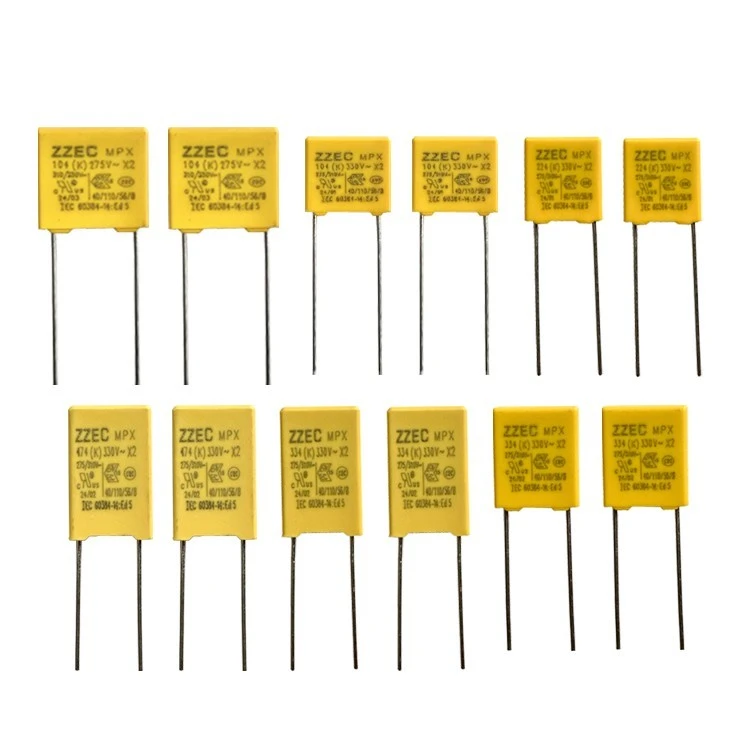

Suitability of Mkp 275v X2 Capacitors for Filter Circuits
Advantages
- Low Dielectric Loss: The polypropylene dielectric in Mkp 275v X2 capacitors has a very low dielectric loss factor. This means that the capacitor dissipates very little energy as heat when an alternating current (AC) signal passes through it. In filter circuits, low dielectric loss is essential for maintaining high efficiency and minimizing power dissipation, especially in high - frequency applications.
- Self - Healing Property: One of the key advantages of metalized polypropylene film capacitors is their self - healing ability. If a breakdown occurs in the dielectric due to a high - voltage spike or other electrical stress, the metalized layer around the breakdown point vaporizes, isolating the damaged area and restoring the capacitor's functionality. This self - healing property ensures the long - term reliability of the capacitor in filter circuits, reducing the risk of component failure and system downtime.
- High Insulation Resistance: Mkp 275v X2 capacitors have high insulation resistance, which means they can effectively isolate different parts of the circuit and prevent leakage currents. In filter circuits, high insulation resistance is important for maintaining the integrity of the signal and preventing interference between different components.
- Safety Compliance: The X2 safety class of these capacitors makes them suitable for use in across - the - line applications. They are designed to meet international safety standards, such as IEC 60384 - 14, which ensures that they can be safely used in electrical equipment without posing a risk of electrical shock or fire. This safety compliance is crucial in filter circuits used in consumer electronics, industrial equipment, and other applications where safety is a top priority.
Limitations
- Capacitance Range: The capacitance values of Mkp 275v X2 capacitors are typically limited to a certain range. While they are available in a variety of capacitance values, there may be applications where a specific capacitance value outside the available range is required. In such cases, alternative capacitor technologies or a combination of capacitors may need to be considered.
- Frequency Response: Although Mkp 275v X2 capacitors can be used in a wide range of frequencies, their performance may degrade at very high frequencies. At high frequencies, the parasitic inductance and resistance of the capacitor can become significant, affecting its ability to filter the signal effectively. Therefore, for applications requiring very high - frequency filtering, other types of capacitors or more complex filter designs may be necessary.
Real - World Applications
In power supplies, Mkp 275v X2 capacitors are often used in EMI suppression filters. These filters are designed to reduce the electromagnetic interference generated by the power supply and prevent it from being transmitted to the connected equipment or the electrical grid. By using Mkp 275v X2 capacitors in the filter circuit, the power supply can meet the strict electromagnetic compatibility (EMC) requirements, ensuring reliable operation of the equipment and compliance with regulatory standards.
In consumer electronics, such as televisions, computers, and audio systems, these capacitors are used in the input stage of the power supply to reduce electrical noise and improve the overall performance of the device. They help to eliminate the hum and interference that can affect the quality of the audio and video signals, providing a cleaner and more stable power supply.
Comparison with Other Capacitor Types
When compared to other types of capacitors, such as ceramic capacitors and electrolytic capacitors, Mkp 275v X2 capacitors have some distinct advantages. Ceramic capacitors are often used for high - frequency applications, but they may have a higher dielectric loss and lower self - healing ability compared to polypropylene capacitors. Electrolytic capacitors, on the other hand, can provide high capacitance values but are generally not suitable for across - the - line applications due to their polarity and lower safety ratings.
However, for applications where high capacitance values are required at low frequencies, electrolytic capacitors may be a better choice. And for very high - frequency applications, ceramic capacitors may offer better performance in terms of frequency response.
Conclusion
Mkp 275v X2 capacitors are generally well - suited for many filter circuits, especially those used in EMI suppression and across - the - line applications. Their low dielectric loss, self - healing property, high insulation resistance, and safety compliance make them a reliable and efficient choice for reducing electrical noise and interference. However, it's important to consider the specific requirements of the application, such as the required capacitance value, frequency range, and voltage rating, when selecting a capacitor for a filter circuit.
If you are looking for high - quality Mkp 275v X2 capacitors for your filter circuits, we are a reliable supplier. Our products, such as the X2 - Anti - Jamming Film Capacitor 275V and 105K275v X2, are designed to meet the highest industry standards and provide excellent performance. We also offer X2 - Anti - Jamming Film Capacitor 310V for applications requiring a higher rated voltage.
If you have any questions or would like to discuss your specific requirements, please feel free to contact us for further information and to start a procurement negotiation.
References
- IEC 60384 - 14: Fixed capacitors for use in electronic equipment - Part 14: Sectional specification - Fixed metalized polypropylene film dielectric d.c. capacitors
- Horowitz, P., & Hill, W. (1989). The Art of Electronics. Cambridge University Press.
- Sedra, A. S., & Smith, K. C. (2015). Microelectronic Circuits. Oxford University Press.