




How to calculate the required capacitance of an Mkp Capacitor for a given application?
 Nov 03, 2025|
 Hey there! As a supplier of Mkp Capacitors, I often get asked about how to calculate the required capacitance for a given application. It's a crucial question because getting the right capacitance is key to making sure your circuit works as it should. So, let's dive into it and break down the process step by step.
Understanding the Basics of Capacitance
First things first, what exactly is capacitance? Capacitance is a measure of a capacitor's ability to store an electric charge. It's measured in farads (F), but in most real - world applications, we use microfarads (μF), nanofarads (nF), or picofarads (pF).
The basic formula for capacitance is (C=\frac{Q}{V}), where (C) is capacitance, (Q) is the charge stored on the capacitor, and (V) is the voltage across the capacitor. But when it comes to calculating the required capacitance for an application, we usually need to consider other factors too.
Factors Affecting Capacitance Requirements
Voltage Rating
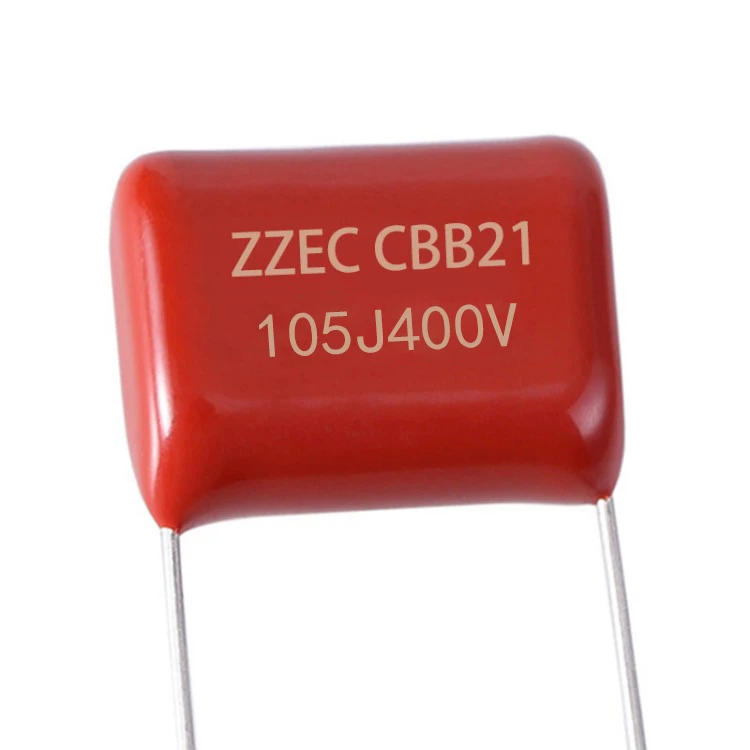
One of the most important factors is the voltage rating. You need to make sure that the capacitor can handle the maximum voltage that will be applied across it in your circuit. If the voltage exceeds the capacitor's rating, it can lead to breakdown and damage. For example, if your circuit has a peak voltage of 300V, you'd want to choose a capacitor with a voltage rating higher than that, say 400V or more. We have a great range of high - voltage rated Mkp Capacitors, like the CBB21 - Film Capacitor 400V.
Frequency of the Circuit
The frequency of the electrical signal in your circuit also plays a big role. Different applications have different frequency requirements. For high - frequency circuits, you need a capacitor that can respond quickly to changes in the signal. Mkp Capacitors are known for their excellent high - frequency performance. In low - frequency circuits, the capacitance requirements might be different, and you might be able to get away with a larger - value capacitor.
Load Requirements
The load in your circuit, whether it's a motor, a light, or some other component, will determine how much charge the capacitor needs to store and release. For example, a motor might require a capacitor to provide a large burst of energy during startup. So, you need to calculate the capacitance based on the load's power requirements and the time it needs the energy.
Calculating Capacitance for Different Applications
Power Factor Correction
Power factor correction is a common application where capacitors are used. The goal is to improve the efficiency of the electrical system by reducing the reactive power. The formula for calculating the capacitance required for power factor correction is (C=\frac{P}{\omega V^{2}}(\tan\varphi_{1}-\tan\varphi_{2})), where (P) is the real power, (\omega = 2\pi f) (with (f) being the frequency), (V) is the voltage, (\varphi_{1}) is the initial phase angle, and (\varphi_{2}) is the desired phase angle.
Let's say you have a small industrial motor with a real power of 1kW, operating at a frequency of 50Hz and a voltage of 230V. You want to improve the power factor from 0.7 to 0.9. First, calculate (\omega = 2\pi\times50 = 314) rad/s. Then, (\tan\varphi_{1}=\tan(\arccos(0.7))\approx1.02) and (\tan\varphi_{2}=\tan(\arccos(0.9))\approx0.48). Plugging these values into the formula, we get (C=\frac{1000}{314\times230^{2}}(1.02 - 0.48)\approx32\mu F).

Filtering Circuits
In filtering circuits, capacitors are used to block DC and allow AC to pass through or vice versa. For a simple RC (resistor - capacitor) low - pass filter, the cutoff frequency (f_{c}=\frac{1}{2\pi RC}). If you know the desired cutoff frequency and the value of the resistor (R), you can rearrange the formula to find the capacitance (C=\frac{1}{2\pi Rf_{c}}).
For example, if you want a cutoff frequency of 1kHz and you have a resistor of 1kΩ, then (C=\frac{1}{2\pi\times1000\times1000}\approx0.16\mu F).
Choosing the Right Mkp Capacitor
Once you've calculated the required capacitance, it's time to choose the right Mkp Capacitor. We offer a wide range of options, like the Cbb21 series. These capacitors are made with high - quality metalized polypropylene film, which gives them excellent electrical properties.
If you need a specific value, we have products like the Cbb21 105j400v. The "105" indicates a capacitance of (1\mu F) (using the capacitor code system where the first two digits are the significant figures and the third is the multiplier), the "j" represents a tolerance of ±5%, and the "400v" is the voltage rating.
Conclusion
Calculating the required capacitance of an Mkp Capacitor for a given application might seem a bit daunting at first, but if you understand the basic principles and consider the factors like voltage rating, frequency, and load requirements, it becomes much easier. And with our wide range of Mkp Capacitors, you're sure to find the right one for your needs.
If you're in the market for Mkp Capacitors and need help with your application or just want to discuss your requirements, don't hesitate to reach out. We're here to assist you in getting the best capacitor solution for your project.
References
- Dorf, R. C., & Svoboda, J. A. (2016). Introduction to Electric Circuits. Wiley.
- Fitzgerald, A. E., Kingsley, C., & Umans, S. D. (2013). Electric Machinery. McGraw - Hill.