



Switching Power Supply Film Capacitor Selection Guide: From Parameters To Application—Avoid These Critical Pitfalls
 Dec 09, 2025|
 I. Core Technical Parameters: The "Hard Requirements" for Selection
The requirements for film capacitors in switching power supplies focus on three key dimensions: low loss, high ripple tolerance, and wide-temperature stability. Below is an analysis of the critical parameters:
| Parameter Name | Significance and Impact | Key Requirements for Switching Power Supplies |
| Rated Voltage | The maximum voltage a capacitor can withstand; overvoltage causes breakdown | Require a margin of 20%-50% above operating voltage (e.g., select ≥16V for 12V circuits). For AC applications, select based on 1.7 times peak voltage (IEC standard). |
| Dielectric Type | Determines capacitor loss, temperature stability, and self-healing properties | Polypropylene (PP) preferred: Low loss (tanδ ≤ 0.001), strong self-healing properties, suitable for high-frequency DC-Link/buffer circuits. Polyester (PET) suitable for low-cost, low-frequency filtering. |
| Ripple Current Capacity | The maximum AC ripple current a capacitor can handle; excessive current causes overheating and damage | Calculate the ripple current RMS value to ensure it does not exceed the capacitor's rated value at maximum operating temperature (one of the primary causes of switching power supply failure). |
| Loss Tangent (tanδ) | Reflects energy loss; lower values indicate higher efficiency | For high-frequency applications (e.g., 500kHz switching frequency), ensure ≤0.002 to reduce heat generation and energy waste. |
| Temperature Coefficient | The rate at which capacitance value changes with temperature | For wide temperature ranges (-40°C to 125°C), select low-temperature-coefficient types (e.g., PP with near-zero temperature coefficient) to prevent capacitance drift from affecting power supply stability. |
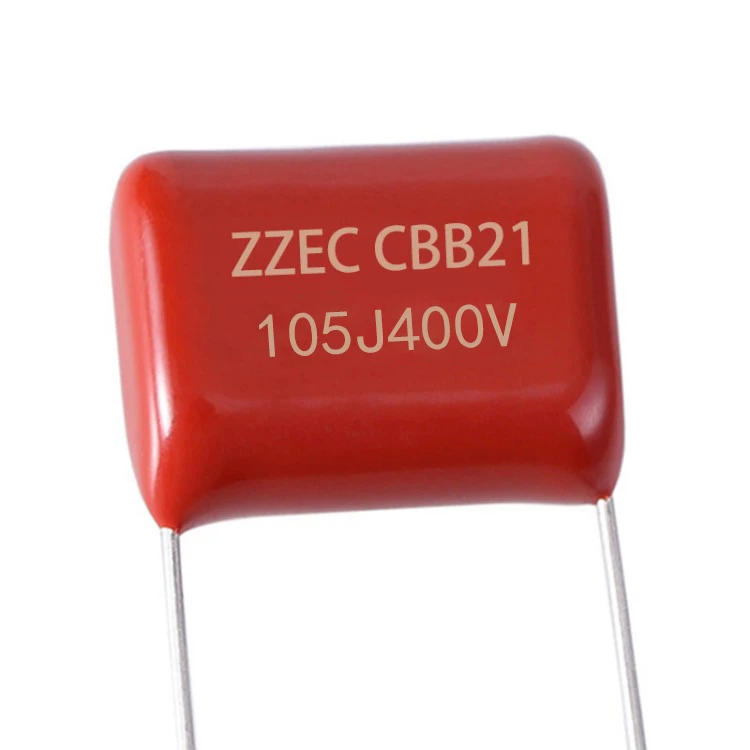
II. Application-Specific Selection: Core Applications for Switching Power Supplies
The selection logic for film capacitors in switching power supplies varies significantly based on their application scenarios:
DC-Link Support Capacitors
Requirements: High ripple tolerance, low ESR (equivalent series resistance), wide temperature stability
Selection: Metallized polypropylene capacitors (MKP), must satisfy ripple current ≥ circuit RMS value (e.g., PV inverter DC-Link capacitors require withstanding over 10A ripple)
Standard: Compliant with IEC 60384-2 requirements for high-voltage, high-current capacitors
Snubber Capacitors
Requirements: Rapid absorption of IGBT switching spikes, strong self-healing capability
Selection: Polypropylene capacitors (excellent self-healing), capacitance matched to switching frequency (e.g., 0.1μF~1μF for 10kHz switching)
Safety Filter Capacitors
Requirements: Suppression of electromagnetic interference (EMI), compliance with safety standards
Selection: X2-rated film capacitors (bridging live and neutral lines), must pass 10kV impulse test (industrial power supply standard)
Resonant Capacitors
Requirements: High precision, low loss, high stability
Selection: Polysulfone (PPS) capacitors, tolerance ≤±5%, temperature coefficient ≤±10ppm/℃

III. Practical Case Studies: Performance Enhancement Through Component Optimization
Case 1: Industrial Frequency Converter
The output stage of a frequency converter originally used polyester capacitors, which failed due to excessive ripple current causing overheating. After replacing them with metallized polypropylene capacitors (30% higher ripple tolerance), the failure rate decreased by 25%, and the service life extended to over 5 years (based on laboratory test data).
Case 2: Vehicle Charger
To meet the wide temperature range requirement of -40°C to 125°C, PPS dielectric film capacitors were selected. Their temperature coefficient ≤ ±5 ppm/°C ensures stable output in extreme environments, passing automotive electronics reliability testing (ISO 16750).
Case 3: Switching Power Supply Filtering
A 12V/2A switching power supply originally used polyester capacitors, resulting in excessive ripple (>200mV). After replacing them with low-loss polypropylene capacitors (tanδ ≤ 0.001), ripple dropped below 50mV and efficiency improved by 3% (Weidian Electronics Application Case).

IV. Pitfall Avoidance Strategies: Steer Clear of These "Hidden Traps"
Common selection errors can lead to premature capacitor failure. Below are key avoidance methods:
Insufficient Voltage Derating
Error: Ignoring AC voltage peaks (e.g., 220V AC actual peak 311V) and selecting based solely on RMS value
Strategy: For AC applications, select capacitors rated for 1.2 times the peak voltage. For DC applications, allow a 20% margin (e.g., select ≥16V capacitors for 12V DC)
Underestimating Ripple Current
Error: Failing to calculate ripple tolerance at elevated temperatures (capacitor ripple tolerance decreases with rising temperature)
Strategy: Refer to the manufacturer's high-temperature ripple curve in the datasheet to ensure actual ripple ≤ 80% of the rated tolerance
Temperature Range Mismatch
Error: Substituting a 105°C capacitor for a 125°C capacitor, resulting in reduced lifespan in high-temperature environments (lifespan halves for every 10°C increase)
Strategy: Select capacitors rated for power supply's maximum operating temperature +10°C (e.g., for 85°C operating temperature, use 105°C capacitors)
Mechanical Stress Installation
Error: Excessive lead bending angle (>90°) causing internal connection failure
Strategy: Use surface-mount (SMD) or radial-lead capacitors to avoid mechanical stress on axial leads
Conclusion
Selecting film capacitors requires balancing performance, cost, and reliability. Engineers should prioritize products compliant with international standards such as IEC 60384-2, considering power supply types, environmental conditions, and technical specifications. As switching power supplies evolve toward higher frequencies and miniaturization, low-ESR, highly integrated film capacitors will become the mainstream trend-choosing the right capacitor makes the power supply's "heart" stronger.