



Guide To Selecting Explosion-Proof Film Capacitors: Professional Guidance Based On 2026 Industry Standards And Research Findings
 Mar 27, 2026|
 I. Special Performance R
equirements for Film Capacitors in Explosion-Proof Applications
Unlike ordinary consumer applications, film capacitors used in explosion-proof equipment must meet both electrical performance and explosion-proof safety requirements. The key constraints include the following three points:
Explosion-proof rating requirements: Must comply with the GB 3836-2021 series of standards. The appropriate explosion-proof type must be selected based on the hazardous area classification of the application (gas environments: Zones 0/1/2; dust environments: Zones 20/21/22). In high-risk areas such as Zone 0, intrinsically safe (Ex ia) design must be adopted. Circuit energy must be controlled within the safety thresholds of voltage ≤ 28 V and current ≤ 0.1 A to ensure that explosive mixtures will not be ignited in the event of a fault.
Extreme operating condition tolerance requirements: For special regions such as Northwest China, which experience strong winds and sand, high corrosion, and extreme temperature fluctuations, capacitors must meet an IP65 or higher protection rating. The operating temperature range must cover at least -40°C to +85°C, and for certain high-temperature scenarios, wide-temperature specifications ranging from -55°C to +125°C are required.
High Reliability Requirements: Explosion-proof equipment typically requires core components to have a service life of no less than 100,000 hours. Capacitors must possess excellent self-healing capabilities, and their ripple current withstand capacity must be at least 20% higher than the actual operating conditions to prevent performance degradation caused by heat generation.
II. Five-Step Core Component Selection Process (Standardized Method Based on Research and Validation)
Step 1: Matching Scenario Risk Levels with Explosion-Proof Parameters
First, classify the hazard level of the work area in accordance with GB 50058 "Code for Design of Electrical Installations in Explosive Atmospheres" to clarify three core parameters:
Hazard Zone Type: Distinguish between gas and dust environments to determine the Zone classification (e.g., Zone 0 requires intrinsically safe type; Zone 1 may use flameproof or intrinsically safe type)
Hazardous Substance Category: Gas media are classified by minimum ignition current ratio into IIA (propane, etc.), IIB (ethylene, etc.), and IIC (hydrogen/acetylene, etc.); dust media are classified into IIIA (combustible fibers), IIIB (general combustible dust), and IIIC (metal dust). Higher-grade explosion-proof equipment is downward compatible with lower-grade scenarios, but the reverse is prohibited
Temperature Class: The maximum surface temperature of the equipment must be below the flash point of the surrounding combustible materials. Classes range from T1 (≤450°C) to T6 (≤85°C). For example, in environments containing low-flash-point chemicals such as ethyl nitrate, T6-class equipment must be selected.
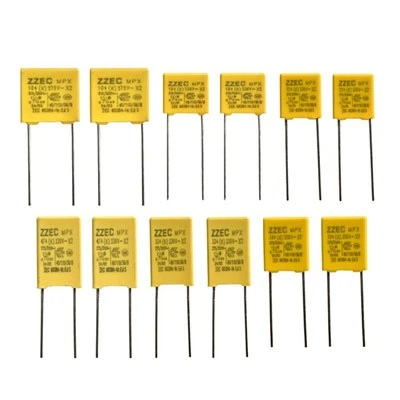
Step 2: Selecting Dielectric Materials
Select the appropriate film dielectric based on the circuit characteristics. Research data indicates that three types of dielectrics are currently the mainstream choices for explosion-proof applications:
| Media Type | Key Advantages | Applications | Suitability for Explosion-Proof Environments |
| Polypropylene film (MKP/PP) | Dissipation tangent ≤ 0.1%, excellent high-frequency performance, strong self-healing capability, insulation resistance ≥ 10 MΩ | High-frequency circuits, DC-link support, buffering and damping, safety circuits | Highly recommended; suitable for over 90% of industrial explosion-proof environments |
| Polyester film (MKT/PET) | Dielectric constant of 3.3, smaller size and lower cost for the same capacitance | DC or low-frequency coupling, filtering, bypass | Ideal for low-risk Zone 2 areas where space is limited and there is no need for high-frequency, high-current applications |
| Polyphenylene sulfide film (PPS) | Minimal temperature coefficient, operating temperature range from -55°C to +125°C, chemical resistance | High-temperature, high-precision control circuits | Suitable for specialized chemical environments with extreme temperature fluctuations and high corrosion |
Step 3: Verification of Electrical Parameters
Core parameters must be confirmed in strict accordance with derating principles. Research indicates that 80% of capacitor failures are related to parameter mismatches:
Rated Voltage: Under DC conditions, the operating voltage must not exceed 80% of the rated value. Under AC conditions, the AC withstand voltage parameters must be verified separately. In applications involving pulse voltages, the peak voltage must be lower than the rated value.
Ripple Current: Select a specification where the allowable ripple current at the highest operating temperature is 20% higher than the actual circuit value to prevent excessive heating.
Tolerance: For general filtering applications, ±10% or ±20% tolerance is acceptable; for precision control circuits, select specifications with ±5% or higher accuracy.
Step 4: Confirmation of Encapsulation and Protection Rating
Select the appropriate encapsulation based on the installation environment:
For outdoor or high-dust environments, prioritize plastic-encapsulated epoxy structures with a protection rating of at least IP65.
Intrinsically safe circuits must be used in conjunction with safety isolators, and capacitors must pass intrinsically safe parameter testing and certification.
In corrosive environments, select stainless steel enclosures or nickel-plated lead packaging to prevent poor contact caused by lead oxidation.
Step 5: Compliance Verification
Mandatory CCC certification requirements for explosion-proof electrical products will take effect in May 2025. As core components of explosion-proof power distribution equipment, variable frequency drives, and other devices, capacitors must meet the following compliance requirements:
They must obtain explosion-proof CCC certification along with the complete unit; prioritize products already included in the list of qualified suppliers.
Provide an explosion-proof performance test report issued by a third-party testing agency, including verification data for temperature group and gas group compatibility.
Starting in March 2026, high-risk explosion-proof products must be accompanied by a CCC traceability QR code, which can be scanned to verify certificate validity and obtain information on the manufacturer.

III. Typical Application Selection Examples (Based on Field Project Research)
Case 1: Coal Chemical Hydrogenation Unit (Zone 1, IIC hydrogen atmosphere, Temperature Class T3)
Selection Plan: Explosion-proof polypropylene film capacitors (Ex d IIC T3) are selected for the DC-Link circuit of the variable frequency drive. Rated voltage: 1200 V (actual operating voltage: 800 V, 67% derating); ripple current capacity: 120 A (actual operating conditions: 80 A, 50% margin); protection rating: IP66
Installation Requirements: To be used with a positive-pressure control cabinet; the cabinet must be filled with nitrogen to maintain a positive pressure of 500 Pa or higher; the cabinet's seal integrity must be tested quarterly.
Case 2: Underground Coal Mine Methane Monitoring System (Zone 0, Class I methane environment, Temperature Class T4)
Selection Plan: Intrinsically safe polypropylene film capacitors (Ex ia I T4) are selected for the sensor signal circuit, with a rated voltage of 35V (actual operating voltage 24V, 69% derating). Circuit current is limited to 80mA or less, and the capacitors are used in conjunction with an isolation safety barrier.
Installation Requirements: Circuit energy parameters must be tested every six months to ensure they remain within safe thresholds at all times.
Case 3: Dust Environment in an Aluminum Powder Processing Workshop (Zone 21, Class IIIC metal dust, Temperature Class T5)
Selection Plan: Dust-proof polyester film capacitors (DIP A21 T5) are selected for the dust collection equipment control circuit. The enclosure features a dust-tight sealed design, with a maximum surface temperature of ≤100°C, and is equipped with an electrostatic grounding device.
IV. Common Selection Pitfalls and Recommendations for Avoiding Them
According to data from the Ministry of Emergency Management's 2025 special inspection on explosion-proof electrical equipment, 37% of safety hazards in explosion-proof equipment stem from improper capacitor selection. Typical pitfalls include:
Confusing protection ratings with explosion-proof ratings: IP65 only indicates dust and water resistance and has no relation to explosion-proof performance. Explosion-proof products must possess both an explosion-proof marking (e.g., Ex d) and protection rating certification
Insufficient conservatism in Zone classification: If the probability of leakage in a given area cannot be clearly determined, it is recommended to select equipment based on the next higher Zone classification. For example, if it is unclear whether the area is Zone 1 or Zone 2, configure the equipment according to Zone 1 requirements.
Neglecting dust explosion protection requirements: Applications involving flour, metal dust, and similar scenarios must separately comply with the GB 12476.1 dust explosion protection standard; gas explosion-proof products alone cannot be used as substitutes.
Inadequate implementation of derating requirements: In high-temperature environments, the rated voltage must be derated by an additional 10% to prevent a decline in withstand voltage performance due to rising temperatures.
Industry experts advise that a full lifecycle management mechanism should be established for the selection of film capacitors used in explosion-proof equipment: verify the compatibility of explosion-proof parameters with the application scenario prior to procurement; inspect sealing and grounding performance during installation; and commission a third-party organization to conduct specialized explosion-proof performance testing every three years. This approach can effectively reduce capacitor-related safety risks by more than 90%.